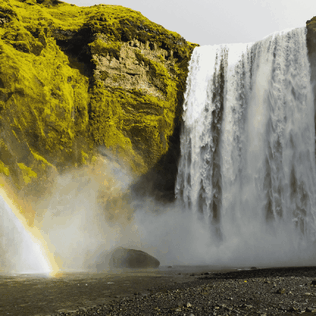
Few sights on Iceland’s South Coast make an entrance quite like Skógafoss. This 60-metre curtain of water thunders down a former sea cliff roughly 150 km east of Reykjavík, and the best part is that you can walk right up to it. Seeing the falls costs nothing, although there is a fee to park.
The name translates as “Forest Falls”, a nod to the woodland that once covered this stretch of coast. In this guide, the Thrifty.is team covers what you need for a smooth visit under your own steam: how to drive there, how parking works, which trails are worth your time and what to expect from the roads in each season.
Why Skógafoss Belongs on Your Itinerary
You’ll spot Skógafoss from the Ring Road long before you reach the turn-off, and it only gets more impressive up close.
- Sheer scale. At 25 metres wide with a 60-metre drop, it ranks among Iceland’s biggest and most photogenic waterfalls.
- Easy to reach. The ground in front of the falls is flat and open, so almost anyone can stroll to the base and feel the roar and the spray for themselves.
- Bring a rain layer. The falls throw up a constant cloud of mist. A proper waterproof jacket and sturdy boots will keep the visit comfortable.
- Rainbows on demand. When the sun is out, the spray regularly produces a rainbow, and sometimes a double one, which is why photographers flock here.
- A legend of hidden gold. Local folklore says the area’s first Viking settler, Þrasi Þórólfsson, stashed a chest of treasure in a cave behind the water. Plenty have looked; nobody has found it.
- Screen fame. Film and TV fans may recognise the setting from Marvel’s Thor: The Dark World and HBO’s Game of Thrones.
Arriving in your own rental car means you set the schedule, not a tour bus, and that freedom is what turns a quick photo stop into a highlight of the trip.
How to Get to Skógafoss by Car
Getting to Skógafoss could hardly be simpler: the falls sit just a couple of minutes off Route 1, the Ring Road that loops around the whole country. The road is paved and maintained year-round, so there are no gravel tracks or mountain passes between you and the car park. A Thrifty.is rental also lets you time your visit for early morning or late evening, when the crowds thin out.
A couple of Icelandic road rules to keep in mind: the speed limit on paved rural roads is usually 90 km/h, and dipped headlights must be on at all times, day and night.
| Starting point | Distance | Drive time (summer) | Route | Good to know |
|---|---|---|---|---|
| Reykjavík | 150 km | ~2 hrs | Route 1 east | Paved all the way. Watch for fixed speed cameras as you leave towns. |
| Seljalandsfoss | 30 km | ~25 min | Route 1 east | A quick, flat hop between two of the South Coast’s best-known falls. |
| Vík í Mýrdal | 34 km | ~28 min | Route 1 west | Crosses open outwash plains where sudden coastal gusts are common. |
| Keflavík Airport | 196 km | ~2.5 hrs | Route 41, then Route 1 east | Skips central Reykjavík traffic, ideal if you’re heading south straight from your flight. |
Fuel and charging stops near the falls
- N1 Skógar (on site): A self-service pump right by the Skógafoss service area, handy for a quick top-up.
- Hvolsvöllur (about 50 km west): Full-service N1 and Olis stations, fast EV chargers and well-stocked supermarkets.
- Vík (34 km east): Plenty of charging options, including Tesla Superchargers, plus several fuel brands and a good choice of places to eat.
Winter weather can add a lot of time to any drive. Before setting off, check live road conditions on Iceland’s official road information site, Umferdin.is.
Driving in from Reykjavík, Seljalandsfoss or Vík
Heading east from Reykjavík on Route 1, you’ll pass the geothermal town of Hveragerði, then Selfoss and Hella, with volcanic hills on either side. On a clear day the ice cap of Eyjafjallajökull dominates the view ahead. It’s a smooth, fully paved drive and a comfortable one even if you’re new to Icelandic roads.
Already at Seljalandsfoss? Skógafoss is only about 25 minutes further east. Coming from the seaside village of Vík, allow around 28 minutes (34 km) westbound across wide glacial plains. With your own car, it’s easy to shuffle the order of stops if the weather changes.
Travelling as a couple or packing light? A compact car from the Thrifty.is fleet is an economical, easy-to-park choice for this route.
Skógafoss Parking and Visitor Essentials
The Skógafoss car park is just a short, level walk from the base of the falls. Here’s what to know before you pull in:
- Cost: 1,000 ISK (roughly €7) covers parking for the whole day.
- How to pay: Use the Parka.is app or the card-operated pay stations near the entrance. Cameras read number plates automatically, so pay as soon as you arrive to avoid a fine landing on your rental agreement.
- Facilities: Clean public toilets, a small café serving hot drinks and snacks, and information boards on the area’s geology.
- Campsite: A popular campsite sits right next to the car park, so you can fall asleep under the midnight sun or the northern lights with the waterfall as your backdrop.
- Beating the crowds: In peak summer, aim to arrive before 9:00 or after 18:00 for a calmer visit and cleaner photos.
Hiking at Skógafoss: Trails and Preparation
Most visitors snap a few photos at the base and drive on. Give yourself a little longer, though, and you can leave the crowds behind and follow the Skógá river upstream through a gorge lined with smaller waterfalls, where the roar fades to a gentle rush. Two simple rules apply:
- Wear the right footwear. Waterproof hiking boots with good grip are a must, as the spray keeps the paths muddy and slippery in every season.
- Stay on the marked paths. Iceland’s Arctic vegetation is fragile and slow to recover, so keep to the trail to protect it.
The Viewing Staircase and the Fimmvörðuháls Trail
The adventure starts with the steep metal staircase on the right-hand side of the falls.
- The staircase: Around 527 steps lead to a platform at the top. It’s a solid workout, but the views improve at every level, from the falls plunging into the gorge to the coastal plain stretching out to the ocean. Allow 30 to 45 minutes, depending on your pace and photo stops.
- The Fimmvörðuháls trail: Go through the small gate at the top and you’re on the famous Fimmvörðuháls route, a 25 km trek between two glaciers that links Skógar with the Þórsmörk valley. Even a couple of kilometres along it gives you a taste of Iceland at its wildest.
- Quieter alternatives: If you prefer spots with fewer people, the South Coast has other gems worth a detour, such as the peaceful Foss á Síðu waterfall, which is lovely to photograph.
Best Times to Photograph Skógafoss
Great shots of Skógafoss come down to light, so a little planning goes a long way.
- Summer and the midnight sun: From late spring through summer, soft golden light lingers for hours around midnight. You can shoot the falls at 2:00 am with barely another soul around, framed by bright green moss on the cliffs.
- Winter scenes: In winter the falls become a frozen fairy tale, with huge icicles hanging from the dark basalt and snow blanketing the surroundings. On a clear night, you may even catch the northern lights dancing above the top of the falls.
Whatever the season, the spray will soak your gear within seconds. For sharp images and long exposures, pack:
- Several microfibre cloths to wipe your lens between shots.
- A wide-angle lens to fit the full height of the falls and its setting into the frame.
- A sturdy tripod for silky long-exposure water shots that hold steady in the wind.
Picking the Right Car Rental in Iceland for Skógafoss
The best car for the trip depends mostly on when you travel and how far you plan to go. Whatever you choose, the Thrifty.is team in Iceland is on hand to help you get the right fit.
- Summer (June to August): The coastal roads are usually clear, dry and easy going. A compact car or an economy 2WD sedan is plenty for reaching the falls and the main Ring Road sights, and it keeps fuel costs down and parking easy. Travelling as a group or with lots of luggage? A roomy SUV will make the journey more comfortable.
- Winter (November to March): Ice, snow and strong winds make winter driving far more demanding. For the South Coast, we strongly recommend a sturdy 4×4 SUV on quality studded winter tyres for extra grip and ground clearance.
Drive carefully, respect the landscape, and Iceland’s roads will reward you. When you’re ready, book your car online at Thrifty.is and start planning the route.
Visit Skógafoss FAQ
Still fine-tuning your plans? These are the questions we hear most often from travellers heading to Skógafoss.
Can you drive right up to Skógafoss?
Yes. The falls sit beside Route 1, the main South Coast highway, about 150 km east of Reykjavík. The whole way is paved, with no gravel stretches or F-roads, so in the warmer months any type of car will get you there.
Is there parking at Skógafoss?
Yes, there’s a large car park just a short walk from the falls. Parking is paid, with the fees going towards upkeep of the site. You can pay through the Parka.is app or by card at the machines on site.
Can you hike at Skógafoss?
Absolutely, it’s a hiker’s dream. Climb the staircase, pass through the gate at the top and follow the river gorge along what’s often called the “Waterfall Way”. This is also the opening stretch of the 25 km Fimmvörðuháls trail to Þórsmörk.
How long should you spend at Skógafoss?
| Plan | Time needed |
|---|---|
| See the falls from the base and take photos | 30–45 minutes |
| Add an unhurried climb to the top platform | About 1.5 hours |
| Hike the first few kilometres of the river trail | 3–4 hours |
Do you need a 4×4 to visit Skógafoss?
In summer, no: a regular 2WD car handles the paved South Coast roads with ease. In winter, yes, we strongly recommend a 4×4 to cope with sudden snowfall, icy patches and strong gusts on the main roads.