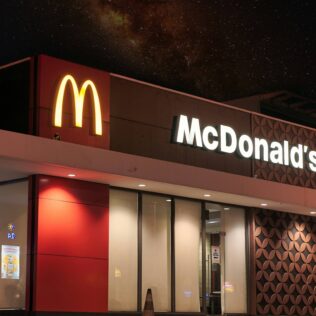
If you land in Iceland and start searching for McDonald’s, Burger King, or other major global fast-food chains, you might be surprised by what you find.
Or more accurately — what you don’t find.
Iceland does have some international brands, but many of the biggest global fast-food names either never entered the market or left years ago.
So what’s going on?
Why would a wealthy, tourism-driven country in Europe not be full of global chains?
The answer is a mix of geography, economics, culture, and Icelandic stubborn independence.
Let’s break it down.
1. Iceland is Small. Very Small.
Iceland has a population of just under 400,000 people. To put that into perspective, that’s smaller than many single European cities. For a major fast-food corporation, that means:
- A limited customer base
- Fewer potential franchise locations
- Slower growth
- Lower economies of scale
Large global chains are built on volume. Iceland simply doesn’t offer the scale they usually depend on.
2. It’s Expensive to Operate Here
Iceland is an island in the North Atlantic. Almost everything that is not produced locally must be imported. That includes:
- Ingredients
- Packaging
- Equipment
- Construction materials
Add to that:
- High wages
- Strict labour laws
- Strong worker protections
- High rent in Reykjavík
Operating costs are significantly higher than in most countries.
When McDonald’s left Iceland in 2009, it wasn’t because Icelanders stopped eating burgers. It was because importing ingredients at competitive prices became too expensive after the financial crisis and currency collapse.
For many chains, the margins just don’t make sense.
3. Iceland Has Strong Food Regulations
Iceland maintains strict food safety and sourcing standards.
Freshness matters. Traceability matters. Local sourcing matters.
Many global chains operate on highly centralised supply systems. Adjusting those systems for a small market like Iceland can be complex and costly.
If a brand cannot import frozen ingredients cheaply and reliably, its standardised global model becomes harder to maintain.
4. Icelanders Support Local Businesses
There’s also a cultural factor.
Iceland has a strong sense of national identity and independence. Supporting local businesses is part of that mindset.
Rather than international chains dominating the market, you’ll find:
- Local burger spots
- Independent cafés
- Family-owned restaurants
- Small Icelandic chains
Even when international brands do enter the market, they often face competition from high-quality local alternatives that feel more authentic.
5. The Tourism Factor Changed the Equation – But Not Completely
Tourism in Iceland has grown dramatically over the past decade. You might assume that would attract more global chains.
And in some cases, it has. Brands like Domino’s and KFC operate in Iceland, and Starbucks finally opened in Reykjavík in 2025.
But tourism is seasonal. Summer sees massive numbers, while winter is quieter. For many global corporations, that level of fluctuation adds risk. Running year-round operations in a small, high-cost country is not always appealing.
6. Local Quality Is Really High
Here’s the part many travellers don’t expect: Iceland’s “fast food” often tastes better than what they’re used to.
Why?
- High-quality local lamb and beef
- Fresh dairy products
- Clean water
- Smaller-scale preparation
When local burger joints are serving fresh, flavourful food, international chains don’t necessarily dominate in the same way they do elsewhere. For many visitors, trying Icelandic fast food becomes part of the experience.
7. It’s Not About Being Anti-Global
Iceland is not closed off to international brands.
You’ll find:
- Domino’s
- Subway
- KFC
- Starbucks (since 2025)
But the absence of certain major chains is more about economics and practicality than ideology.
Iceland is simply a unique market.
So… Will You Miss the Major Chains?
Honestly? Probably not.
When you’re:
- Eating a lamb hot dog in Reykjavík
- Trying a locally made burger after a Golden Circle road trip
- Grabbing fresh pastries at a small-town bakery
The lack of a McDonald’s drive-thru doesn’t feel like a loss. In many ways, it makes Iceland feel less commercial and more distinct.
The Bigger Picture
The reason major fast-food chains are limited in Iceland comes down to:
- A small population
- High operating costs
- Import dependency
- Strong local competition
- Strict regulations
- Seasonal tourism
It’s not that Iceland “doesn’t allow” them. It’s that Iceland operates on different terms.
And that’s part of what makes visiting here feel different.
FAQ
- Why is there no McDonald’s in Iceland?
McDonald’s left Iceland in 2009 after the financial crisis made importing ingredients too expensive. High operating costs, currency fluctuations, and Iceland’s small population made it difficult to maintain profitable operations.
- Why don’t more major fast-food chains operate in Iceland?
Iceland’s small population, high wages, strict food regulations, and reliance on imported goods make it a challenging market for large global chains that depend on high-volume sales and centralised supply systems.
- Are there any International fast-food chains in Iceland?
Yes. Iceland has several global brands, including Domino’s, KFC, Subway, and Starbucks, which opened in Reykjavík in 2025. However, the overall number of international chains is lower than in most countries.
- Is fast food more expensive in Iceland?
Yes. Due to higher wages, import costs, and operational expenses, fast food in Iceland is generally more expensive than in countries like the United States or the UK.
- Do Icelanders prefer local restaurants over global chains?
Many Icelanders support local businesses, and independent restaurants and cafés are very popular. Local burger spots, bakeries, and hot dog stands often compete successfully with international brands.
- Does tourism increase demand for major chains in Iceland?
Tourism has encouraged some global brands to enter the Icelandic market. However, Iceland’s strong seasonality and relatively small year-round population still make it a niche market for many large corporations.
- Is it difficult to find quick, affordable food in Iceland?
Not at all. While some major chains are missing, Iceland offers local fast-food restaurants, supermarkets, petrol station cafés, and street food options that provide convenient and satisfying meals.